Slanted: How the News Media Taught Us to Love Censorship and Hate Journalism by Sharyl Attkisson
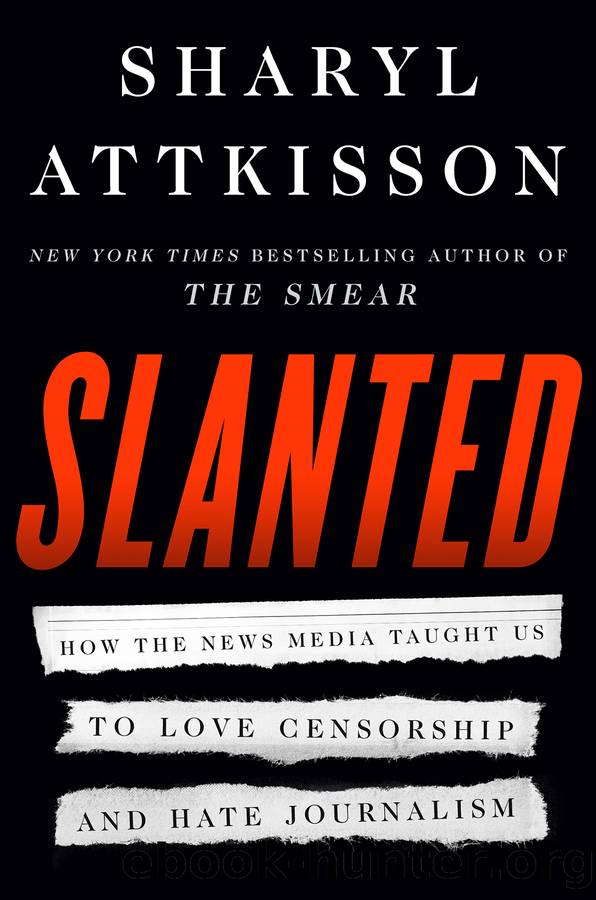
Author:Sharyl Attkisson [Attkisson, Sharyl]
Language: eng
Format: epub
ISBN: 9780062974693
Google: xyRczQEACAAJ
Publisher: HarperCollins Publishers
Published: 2020-07-15T20:31:19.939593+00:00
One notable exception to the media outlets casually throwing around the âLâ word is National Public Radio (NPR). When it came to Trumpâs allegation about illegal immigrants voting, NPR did not call it a âlieâ but said there is âno credible evidence of widespread voter fraud.â
That brings up a second set of news phrases the media invented and deployed specifically against Trump: âno credible evidence,â âno evidence,â and âwithout evidence.â
âWithout Evidenceâ
As a news journalist, I do not recall uttering or hearing the phrase âwithout evidenceâ when reporting on anybody or anything over the course of about thirty-five years. Until we covered Trump.
To show how suddenly and starkly the terminology emerged as part of the lexicon of journalists, I conducted a Google search using the words âTrump without evidence.â It returned 179 million results. I then did the same search for âObama without evidence,â and noneâzeroâof the top results involved the media calling out Obama for claims âwithout evidence.â In fact, searching for âObama without evidenceâ returned primarily stories about, you guessed it, Trump having no evidence for his claims.
At first glance, it might seem as though phrases such as âwithout evidenceâ and âno credible evidenceâ are more fact based and responsible than tossing around accusations of âlies.â But they can be just as problematic.
First, who decides what âevidenceâ is âcredibleâ?
Second, absence of evidence does not necessarily mean a claim is discredited. After all, there was âno evidenceâ that polio could be transmitted via waterâuntil there was. There was âno evidenceâ that some cholesterol is good for your healthâuntil there was.
Third, âwithout evidenceâ is an invented concept for the purpose of slanting reporting. Throughout time, few newsmakers presented âevidenceâ when making statements. It was never expected that each comment or speech would be accompanied by a set of footnotes and citations. Until Trump. Now âwithout evidenceâ is commonly invoked in a one-sided fashion, usually against Trump and his supporters and typically when the media want to call them into question or disparage them.
This trend has helped ensure the mediaâs downward spiral when it comes to the public trust.
Here are a few examples along with my notes. Remember, these phrases did not exist within newsspeak in any meaningful way prior to the press creating them to use against Trump. But you can see that once the word went out, everyone seemed to fall in line and pick up the jargon as if fulfilling orders from a Grand Poobah of Propaganda.
Download
This site does not store any files on its server. We only index and link to content provided by other sites. Please contact the content providers to delete copyright contents if any and email us, we'll remove relevant links or contents immediately.
Whiskies (Collins Gem) by dominic roskrow(45527)
Spell It Out by David Crystal(36236)
Cecilia; Or, Memoirs of an Heiress — Volume 1 by Fanny Burney(32720)
Cecilia; Or, Memoirs of an Heiress — Volume 2 by Fanny Burney(32088)
Cecilia; Or, Memoirs of an Heiress — Volume 3 by Fanny Burney(32065)
Beautiful Disaster by McGuire Jamie(25452)
Trainspotting by Irvine Welsh(21971)
Chic & Unique Celebration Cakes by Zoe Clark(20149)
The Secret History by Donna Tartt(19468)
How High Can a Kangaroo Hop? by Jackie French(18843)
Twilight of the Idols With the Antichrist and Ecce Homo by Friedrich Nietzsche(18775)
All the Missing Girls by Megan Miranda(16697)
Cat's cradle by Kurt Vonnegut(15555)
Ready Player One by Cline Ernest(15139)
For the Love of Europe by Rick Steves(14907)
Fifty Shades Freed by E L James(13349)
4 3 2 1: A Novel by Paul Auster(12611)
Crooked Kingdom: Book 2 (Six of Crows) by Bardugo Leigh(12453)
Grundlagen Kreatives Schreiben (German Edition) by Helfferich Pia(10522)
